
Theory of Shielding and Gasketing:
Fundamental Concepts
A knowledge of the fundamental concepts of EMI shielding will aid the designer in selecting the gasket inherently best suited to a specific design.
All electromagnetic waves consist of two essential components, a magnetic field, and an electric field. These two fields are perpendicular to each other, and the direction of wave propagation is at right angles to the plane containing these two components. The relative magnitude between the magnetic (H) field and the electric (E) field depends upon how far away the wave is from its source, and on the nature of the generating source itself. The ratio of E to H is called the wave impedance, Zw.
If the source contains a large current flow compared to its potential, such as may be generated by a loop, a transformer, or power lines, it is called a current, magnetic, or low impedance source. The latter definition is derived from the fact that the ratio of E to H has a small value. Conversely, if the source operates at high voltage, and only a small amount of current flows, the source impedance is said to be high, and the wave is commonly referred to as an electric field. At very large distances from the source, the ratio of E to H is equal for either wave regardless of its origination. When this occurs, the wave is said to be a plane wave, and the wave impedance is equal to 377 ohms, which is the intrinsic impedance of free space. Beyond this point all waves essentially lose their curvature, and the surface containing the two components becomes a plane instead of a section of a sphere in the case of a point source of radiation.
The importance of wave impedance can be illustrated by considering what happens when an electromagnetic wave encounters a discontinuity. If the magnitude of the wave impedance is greatly different from the intrinsic impedance of the discontinuity, most of the energy will be reflected, and very little will be transmitted across the boundary. Most metals have an intrinsic impedance of only milliohms. For low impedance fields (H dominant), less energy is reflected, and more is absorbed, because the metal is more closely matched to the impedance of the field. This is why it is so difficult to shield against magnetic fields. On the other hand, the wave impedance of electric fields is high, so most of the energy is reflected for this case.
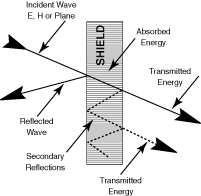
Consider the theoretical case of an incident wave normal to the surface of a metallic structure as illustrated in Figure 1. If the conductivity of the metal wall is infinite, an electric field equal and opposite to that of the incident electric field components of the wave is generated in the shield. This satisfies the boundary condition that the total tangential electric field must vanish at the boundary. Under these ideal conditions, shielding should be perfect because the two fields exactly cancel one another. The fact that the magnetic fields are in phase means that the current flow in the shield is doubled.
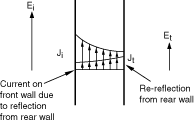
Shielding effectiveness of metallic enclosures is not infinite, because the conductivity of all metals is finite. They can, however, approach very large values. Because metallic shields have less than infinite conductivity, part of the field is transmitted across the boundary and supports a current in the metal as illustrated in Figure 2. The amount of current flow at any depth in the shield, and the rate of decay is governed by the conductivity of the metal and its permeability. The residual current appearing on the opposite face is the one responsible for generating the field which exists on the other side.
Our conclusion from Figures 2 and 3 is that thickness plays an important role in shielding. When skin depth is considered, however, it turns out that thickness is only critical at low frequencies. At high frequencies, even metal foils are effective shields.
The current density for thin shields is shown in Figure 3. The current density in thick shields is the same as for thin shields. A secondary reflection occurs at the far side of the shield for all thicknesses. The only difference with thin shields is that a large part of the re-reflected wave may appear on the front surface. This wave can add to or subtract from the primary reflected wave depending upon the phase relationship between them. For this reason, a correction factor appears in the shielding calculations to account for reflections from the far surface of a thin shield.
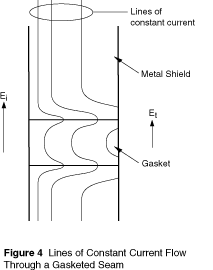
A gap or slot in a shield will allow electromagnetic fields to radiate through the shield, unless the current continuity can be preserved across the gaps. The function of an EMI gasket is to preserve continuity of current flow in the shield.
If the gasket is made of a material identical to the walls of the shielded. enclosure, the current distribution in the gasket will also be the same assuming it could perfectly fill the slot. (This is not possible due to mechanical considerations.)
The flow of current through a shield including a gasket interface is illustrated in Figure 4. Electromagnetic leakage through the seam can occur in two ways. First, the energy can leak through the material directly. The gasket material shown in Figure 4 is assumed to have lower conductivity than the material in the shield. The rate of current decay, therefore, is also less in the gasket. It is apparent that more current will appear on the far side of the shield.
This increased flow causes a larger leakage field to appear on the far side of the shield. Second, leakage can occur at the interface between the gasket and the shield.
If an air gap exists in the seam, the flow of current will be diverted to those points or areas which are in contact. A change in the direction of the flow of current alters the current distribution in the shield as well as in the gasket. A high resistance joint does not behave much differently than open seams. It simply alters the distribution of current somewhat. A current distribution for a typical seam is shown in Figure 4. Lines of constant current flow spaced at larger intervals indicate less flow of current. It is important in gasket design to make the electrical properties of the gasket as similar to the shield as possible, maintain a high degree of electrical conductivity at the interface, and avoid air, or high resistance gaps.
Shielding and Gasket Equations1
The previous section was devoted to a physical understanding of the fundamental concepts of shielding and gasketing. This section is devoted to mathematical expressions useful for general design purposes. It is helpful to understand the criteria for selecting the parameters of a shielded enclosure.
In the previous section, it was shown that electromagnetic waves incident upon a discontinuity will be partially reflected, and partly transmitted across the boundary and into the material. The effectiveness of the shield is the sum total of these two effects, plus a correction factor to account for reflections from the back surfaces of the shield. The overall expression for shielding effectiveness is written as:
SE = R + A + B (1)
where
SE is the shielding effectiveness
R is the reflection factor
A is the absorption factor, and
B is the correction factor to account for reflections from the far boundary
The reflection term is largely dependent upon the relative mismatch between the incoming wave and the surface impedance of the shield. Reflection terms for all wave types have been worked out by others.3 The equations for the three principal fields are given by the expressions:
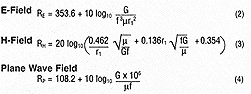
The absorption term A is the same for all three waves and is given by the expression:

The factor B can be mathematically positive or negative (in practice it is always negative), and becomes insignificant when A>6 dB. It is usually only important when metals are thin, and at low frequencies (i.e., below approximately 20 kHz).
References
1. Much of the analysis discussed in this section was performed by Robert B. Cowdell, as published in Nomograms Simplify Calculations of Magnetic Shielding Effectiveness” EDN, page 44, September 1, 1972. 2. Shielding Effectiveness is used in lieu of absorption because part of the shielding effect is caused by reflection from the shield, and as such is not an absorption type loss. 3. Vasaka, G.J., Theory, Design and Engineering Evaluation of Radio-Frequency Shielded Rooms, U.S. Naval Development Center, Johnsville, Pa., Report NADC-EL-54129, dated 13 August, 1956;
The preceding equation was solved in two parts. A digital computer was programmed to solve for B with a preselected value of A, while I K I varied between 10–4 and 103. The results are plotted in Figure 9.
The nomograph shown in Figure 8 was designed to solve for I K I in equation (6). Note that when ZH becomes much smaller than ZS (K>1), large positive values of B may result. These produce very large and unrealistic computed values of S.E., and imply a low frequency limitation on the B equation. In practical cases, absorption losses (A) must be calculated before B can be obtained.
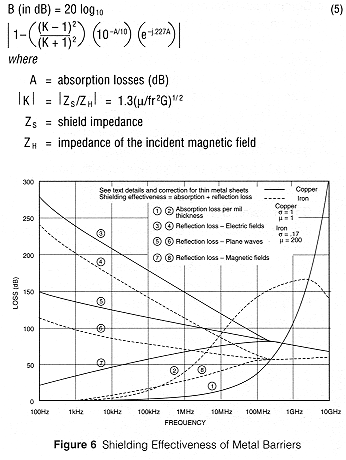
A plot of reflection and absorption loss for copper and steel is shown in Figure 5. This illustration gives a good physical representation of the behavior of the component parts of an electromagnetic wave. It also illustrates why it is so much more difficult to shield magnetic fields than electric fields or plane waves. Note: In Figure 5, copper offers more shielding effectiveness than steel in all cases except for absorption loss. This is due to the high permeability of iron. These shielding numbers are theoretical, hence they are very high (and unrealistic) practical values.
If magnetic shielding is required, particularly at frequencies below 14 kHz, it is customary to neglect all terms in equation (1) except the absorption term A. Measurements of numerous shielded enclosures bears this out. Conversely, if only electric field, or plane wave protection is required, reflection is the important factor to consider in the design.
The effects of junction geometry, contact resistance, applied force and other factors which affect gasket performance are discussed in the design section which follows.
Polarization Effects
Currents induced in a shield flow essentially in the same direction as the electric field component of the inducing wave. For example, if the electric component of a wave is vertical, it is known as a vertically polarized wave, and it will cause a current to flow in the shield in a vertical direction.
A gasket placed transverse to the flow of current is less effective than one placed parallel to the flow of current.
A circularly polarized wave contains equal vertical and horizontal components, so gaskets must be equally effective in both directions. Where polarization is unknown, gasketed junctions must be designed and tested for the worse condition; that is, where the flow of current is parallel to the gasket seam.
Nomographs
The nomographs presented in Figures 6 through 9 will aid the designer in determining absorption and magnetic field reflection losses directly1. These nomographs are based on the equations described in the previous section.
Absorption Loss – Figure 6:
Given a desired amount of absorption loss at a known frequency, determine the required thickness for a known metal:
a. Locate the frequency on the f scale and the desired absorption loss on the A scale. Place a straight-edge across these points and locate a point on the unmarked X scale (Example: A = 10 dB, f =100 kHz).
b. Pivot the straight-edge about the point on the unmarked X scale to various metals noted on the G x μ scale. A line connecting the G x μ scale and the point on the unmarked scale will give the required thickness on the t scale. (Example: for copper t = 9.5 mils, cold rolled steel t = 2.1 mils). Some care must be exercised in using these charts for ferrous materials because μ varies with magnetizing force.
Magnetic Field Reflection – Figure 7: To determine magnetic field reflection loss RH:
a. Locate a point on the G/μ scale for one of the metals listed. If the metal is not listed, compute G/μ and locate a point on the numerical scale.
b. Locate the distance between the energy source and the shield on the r scale.
c. Place a straight-edge between r and G/μ and locate a point on the unmarked X scale (Example: r =10 inches for hot rolled steel).
d. Place a straight-edge between the point on the X scale and the desired frequency on the f scale.
e. Read the reflection loss from the RH scale. (For f = 10 kHz, RH = 13 dB).
f. By sweeping the f scale while holding the point on the X scale, RH versus frequency can be obtained. (For f = 1 kHz, RH = 3.5 dB). (Note that thickness is not a factor in calculating reflection losses.)
Magnetic Field Secondary Reflection Losses I K I Figures 8 and 9: To determine the magnetic field secondary reflection loss factor I K I to solve for B:
Given: r = 2 inches for 0.0162 in. thick copper and A = 1.3 dB. Find B at 1 kHz.
a. Draw a line between copper on the G/μ scale and r = 2 inches on the “source to shield distance scale.” Locate a point on the X scale.
b. Draw a line from the point on the X scale to 1 kHz on the f scale.
c. At its intersection with the I K I scale, read I K I = 2.2 x 10⁻².
d. Proceed to Figure 9.
e. On Figure 9, locate I K I = 2.2 x 10⁻² on the horizontal scale.
f. Move vertically to intersect the A = 1.3 curve (interpolate), and then horizontally to find B = –8.5 dB.
Electromagnetic Compatibility and Interference
Electronic devices operating normally in their intended environment, without conducting or radiating excessive amounts of electromagnetic energy, or being susceptible to such energy from internal or external sources, are in the state of electromagnetic compatibility, or EMC. Electromagnetic interference, EMI, is radiated or conducted energy that adversely affects circuit performance, and thus disrupts a device’s EMC. Many types of electronic circuits radiate or are susceptible to EMI and must be shielded to ensure proper performance. Establishing basic electromagnetic compatibility in any electronic device generally requires two distinct approaches. The first approach is to reduce EMI generated from internal sources. As shown in Figure 1, this is best accomplished by designing an electronic circuit or device so that it inherently generates less EMI. Residual EMI may then be suppressed or contained within the enclosure by appropriate filtering and shielding methods. Filtering cables at the point where they enter or leave the enclosure will reduce conducted emissions.
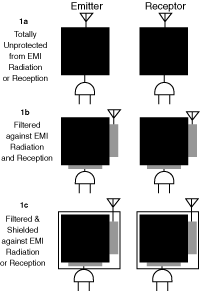
Radiated EMI may be eliminated or reduced by the use of shielded enclosures and shielding materials. The second method for establishing EMC in a device is to improve its immunity (or reduce its susceptibility) to interference from external EMI sources.
Figure 1a illustrates an EMI-susceptible device. Susceptibility to external EMI may be reduced or even eliminated by designing circuits and choosing components which are inherently less sensitive to interference. As in the case of internal sources, conducted EMI may be reduced with filtering devices on incoming and outgoing leads as shown in Figure 1b, and susceptibility to externally radiated EMI may be reduced with use of effective shielding, as illustrated in Figure 1c.
Electromagnetic Fields
Radiating electromagnetic waves consist of both an E-field (electric) and an H-field (magnetic) oscillating at right angles to each other, as illustrated in Figure 2. E-fields are created from voltage sources, such as logic chips or clocks switching between their zero and 5-volt states. H-fields result from current sources, such as motors and transformers.

EMI Regulations
Government regulations in the US and many other countries prohibit electronic products from emitting EMI that could interfere with radio and television receivers. European regulations also include EMI immunity levels. Manufacturers of commercial electronic products generally contend with three types of EMI problems:
Suppression of internally generated signals to prevent excessive levels of radiated and/or conducted emissions
The FCC in the United States, CSA in Canada, VCCI in Japan, AUSTEL in Australia, and legislation by EU (European Union) member countries all set certain standards for EMI emission levels that commercial electronic devices must meet before being sold in those countries. Many electronic products sold in the US must be tested and verified or certified for compliance with the FCC’s Part 15 regulations.
External ambient interference with equipment operation
Many companies establish their own specifications for immunity to EMI over a range of phenomena. These may include electrostatic discharge (ESD), radiated immunity, and electricfast transients (EFT). This is not yet a requirement in the US; however, EU regulations currently do include immunity requirements.
Internally generated emissions interfering with equipment operation
EMI from one circuit can interfere with the function of another within the same system or subsystem. Typically called cross-talk, this problem is the most common source of system susceptibility. Cross-talk frequently occurs in densely packaged mobile or portable equipment.
Design assistance that can make a real difference in time and cost …
As the world’s largest manufacturer of EMI shielding materials, Chomerics offers its customers unparalleled knowledge of system design and regulatory compliance. We encourage you to contact our Applications Engineering Department for practical advice on product selection. Since 1961, vigorous product development in pace with the rapid advances in electronics has made Chomerics a primary force in EMI shielding technology.
If you don’t find the ideal solution, call us. We’re probably working on it!
THERM-A-GAP
GEL 50TBL
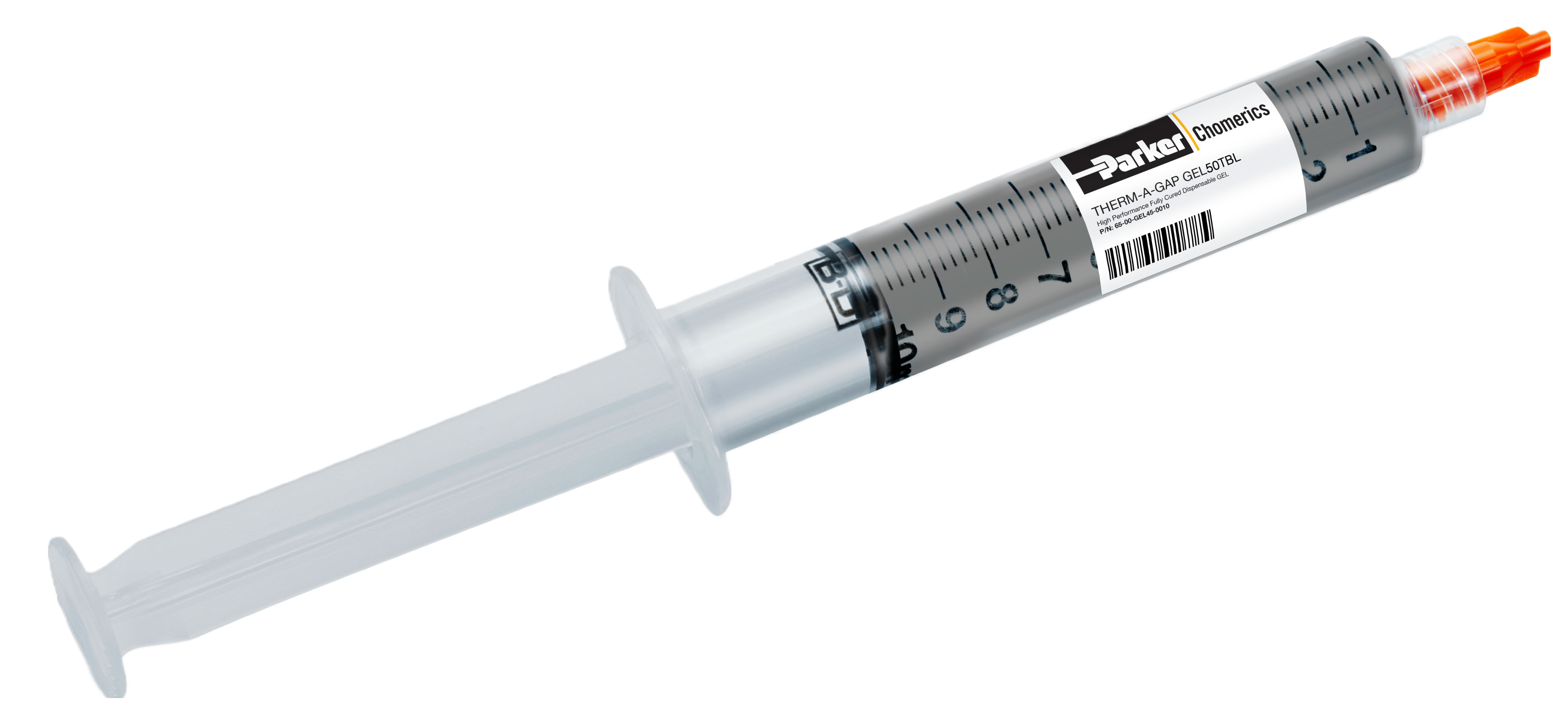
Parker Chomerics THERM-A-GAP GEL 50TBL is a reworkable, high performance, one component, dispensable, thermal interface material with 5.0 W/m-K Bulk Thermal Conductivity.

Solutions for Thermal Interface Materials
Parker Chomerics thermal interface materials transfer heat from electronic components to heat sinks and are used to eliminate air gaps from the interface. Our THERM-A-GAP® materials deliver lower thermal impedance, higher thermal conductivity and greater compliance and conformability to both microelectronics and large scale electronics.
Quality & Reliability that Ensure the Utmost Satisfaction
Our parts are designed and manufactured to perform precisely as advertised, meeting and exceeding all necessary specifications.

Solving EV Charging Station Design Challenges: Thermal Interface Materials and EMI Shielding Solutions
Electric vehicle (EV) battery charging stations, also known as EV charging stations or EVSE (Electric Vehicle Supply Equipment), consist of various electronic components and systems that work together to safely and efficiently charge the batteries of electric vehicles. Like most modern, high power electronics, these devices must overcome challenges associate with thermal management and electromagnetic interference (EMI) shielding in order to operate properly and effectively.

Non-Silicone Dispensable Thermal Gel for Automotive Infotainment and Camera Modules
Automotive electronics designers and engineers have been working with component suppliers to push the boundaries of material properties used to maintain long term reliability of these AVNT and Infotainment systems. The basis for long term reliability has been higher performance processors and chips, leading to secondary design concerns. Electronic modules have to be electrically shielded to prevent interference from nearby modules and also cooled to prevent overheating, a leading cause of electronic device failure. In the case of safety features, device failure is not an option.

Safeguarding Alternative Energy with Engineering Innovation
Around the world, businesses and consumers alike are turning their attention to alternative energy sources such as solar, wind and hydropower.
This growing interest isn’t just hype; it’s backed by large investments in green, sustainable energy, and many companies are hard at work developing a broad suite of innovative products to meet the demand.
We’re constantly innovating in our drive to create the most advanced clean energy solutions.

2023 Thermal Interface Material Innovations
Over the last year, Parker Chomerics has developed new, state of the art thermal interface materials, or TIMs, for use across industries and applications. These novel products continue to expand the portfolio of high performance, high reliability thermal gap pads and dispensable thermal gels.
Can't find what you're looking for? Talk to one of our experts.
