
Problem Solved!
Application Success Stories
From initial concept to production, Parker's engineering teams support many of the world’s leading manufacturers in the ever changing trends of the industry, helping them to expand their geographical footprint and achieve optimal operational efficiency.

Optimizing Aerospace Enclosure Sealing with Fluorocarbon VX065 for Extreme Temperature Fluctuations
Discover how engineers at Parker O-Ring & Engineered Seals (OES) Division tackled a challenging aerospace sealing problem, where extreme temperature fluctuations and high pressures were at play. Their innovative solution, vulcanized - spliced seal with custom-molded corners and extruded hollow cordstock, resolved the customer's unique needs. Also, learn how fluorocarbon VX065 emerged as the ultimate choice, making this sealing solution a game-changer for flight applications.
Sealing Challenge:
A recent flight application required a forty-inch-long cover seal on an aluminum housing that was expected to flex once loaded, creating a clearance gap up to .010”, resulting in an increased groove depth. Minimizing gas permeation into the enclosure was the challenge, with retention of the seal in the groove desirable for occasional opening of the cover. Application pressures could fluctuate up to 30 psi with temperature extremes as low as -65°F (-54°C) or as high as 300°F (149°C).
An extruded hollow cord would minimize the compressive load force, however the tight radius bend on the cover would cause excessive stress on the seal material at the corners. A molded, low closure force, lip seal would be an ideal solution. However, tooling costs can be prohibitive for such a large seal footprint.

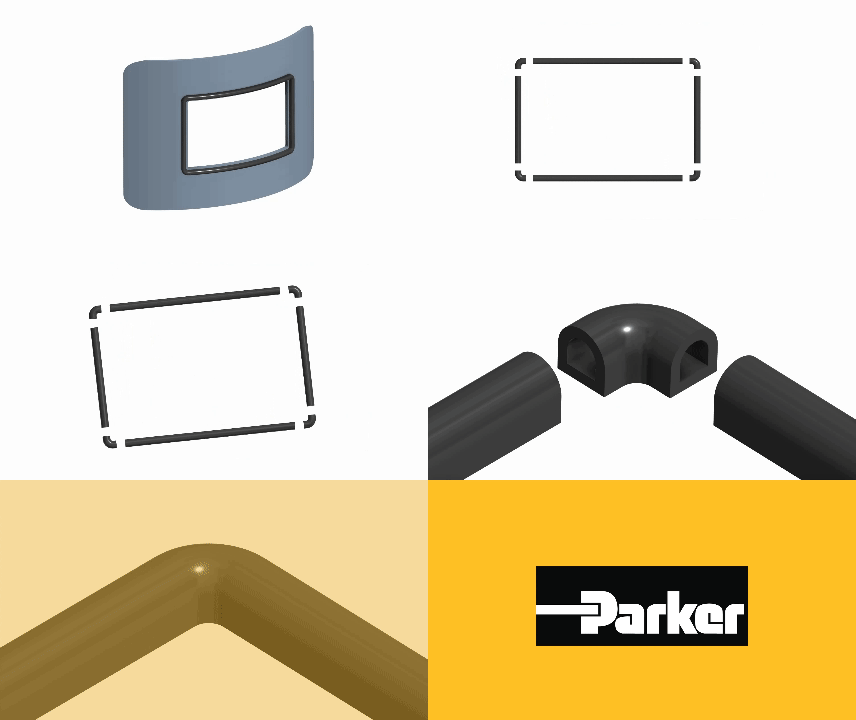
Custom Extruded Hollow D Seal with Molded Corners
Sealing Solution:
Parker engineers proposed a vulcanized - spliced seal design using both molded, hollow corners and extruded hollow cord stock. A Hollow D configuration could be designed for increased compression to accommodate the flexion on the housing. Hollow profiles require much less closure force than a solid seal. The tight bend radius concern for the cord stock was solved by using a custom molded corner joint which was also hollow. The corner sections were perfectly sized to the bend radius on the groove cover and could be easily spliced to the lengths of extruded cord stock using the same parent material. Pressure sensitive adhesive was recommended to retain the seal in the groove during sporadic opening of the cover.
Fluorocarbon VX065-75, the only compound currently qualified AMS7410, was recommended because it provides the best permeation resistance in a material capable of accommodating the temperature requirements. While relatively new, it boasts an impressive pedigree for flight applications.
For more information on Parker O-Ring & Engineered Seals (OES) Division's custom sealing solutions and materials, visit us at www.parker.com/oes.
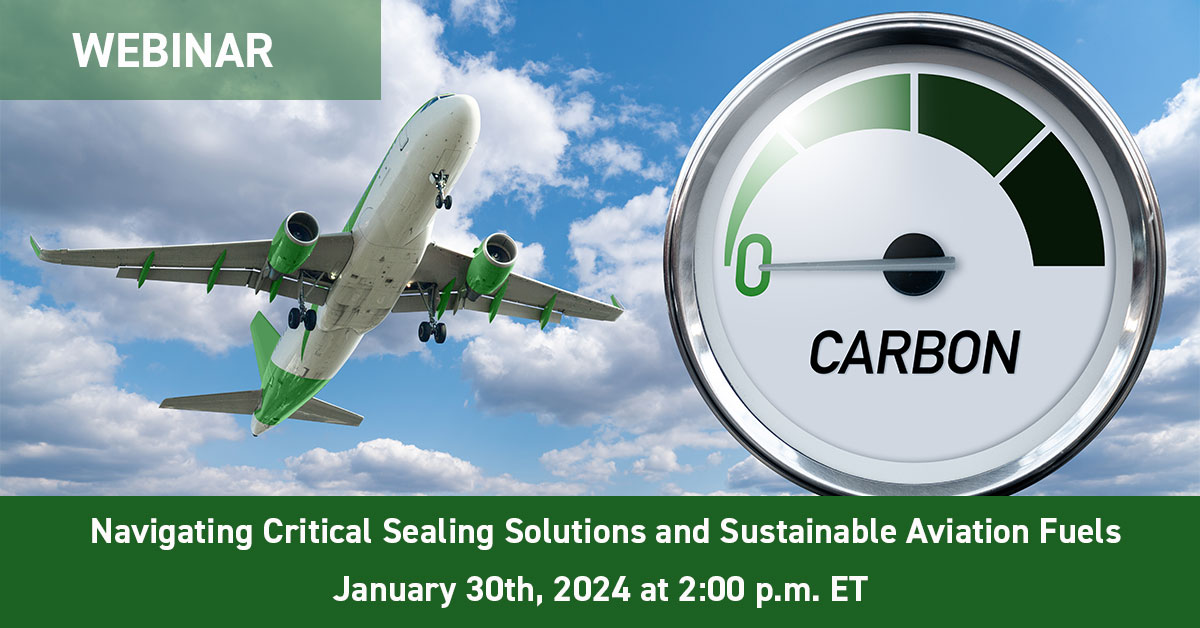
Webinar: Navigating Critical Sealing Solutions & SAF
As the aviation industry continues to evolve towards sustainability, the role of SAFs have become increasingly significant. However, their unique chemical compositions present new challenges for the durability and performance of rubber seals within aircrafts. Join us for a deep dive into the crucial intersection of Sustainable Aviation Fuels (SAFs) and rubber sealing technology in our January webinar.
Parker Hannifin Corporation
O-Ring & Engineered Seals (OES) Division
2360 Palumbo Drive
Lexington, KY 40509
© 2023 All rights reserved.
