
Linear Motion Overview
On this page, you'll find basic and advanced information regarding sizing and selecting linear motion actuators. To view detailed information on stopper cylinders, click here.
Looking for Virtual Engineer?
START THE SIZING PROCESS
- Identify Motion Type: Determine whether the actuator will drive Linear Motion or Arc of Motion.
- Understand Linear Motion: Linear Motion refers to the movement along a straight path, as opposed to Arc of Motion, which involves a lever arm traveling through a minor arc driven by a pivot-mounted cylinder.
- Select Linear Motion: For this example, select Linear Motion within the Linear Motion Sizing tool.
KEY FEATURES
- Generate Results: After entering the minimum data requirements, the "Generate Results" button will become active. Press this button to initiate calculations for potential solutions.
- Compare Solutions: After generating results, the "Compare" button will activate, allowing you to compare the list of potential solutions.
- Save Progress: Use the "Save Progress" button at any time to resume your work later.
- Reset Parameters: The "Reset Parameters" option should only be used if you want to start over, as it will clear all entered data.
- Metric/Imperial Selector: Toggle between metric and imperial units for all inputs. You can also override this setting for individual inputs.
- My Project Section: Access the "My Project" button to store your information. Here, you can share your projects internally or externally with customers or suppliers.
Looking for more help? Download the detailed guide.
INPUT INITIAL DATA
- Review the Detailed Guide: Consult the detailed guide for information on all inputs, including descriptions and parameters. It is recommended to save this file for easy reference.
- Enter Operating Parameters: In the Operating Parameter section, input data for operating pressure, temperature minimum, temperature maximum, and tubing length. The operating pressure, temperature minimum, and temperature maximum have default values that can be adjusted.
- Mandatory Data Entry: The first mandatory data entry is tubing length, which is the distance from the valve to the actuator.
- Select Application Type: Choose the application type from options such as Cantilever, Pivot Span, or Stopper.
- Define Load Attachment: Indicate whether the load attached to the actuator will be fixed or able to pivot.
- Specify Load Support: Choose how the load will be supported in the application by selecting options such as not guided, rigidly guided, or supported but not rigidly guided.
- Enter Attached Mass: Input the attached mass and offsets to the center of gravity.
- Coefficient of Friction: If the load is guided or supported, enter the coefficient of friction for that load support.
- Orientation of Actuator: Define how gravity will affect the calculations by inputting data for attached mass and offsets to the center of gravity. The image will update to reflect your inputs.
- Adjust Orientation: Adjust roll and pitch using sliders or by entering exact values. You can also rotate the view for a different perspective.
- Add External Stops: Define an external stop located near the end of the travel.
- Preset Views: Use the Initial XY View, YZ View, and XZ View buttons for preset views.
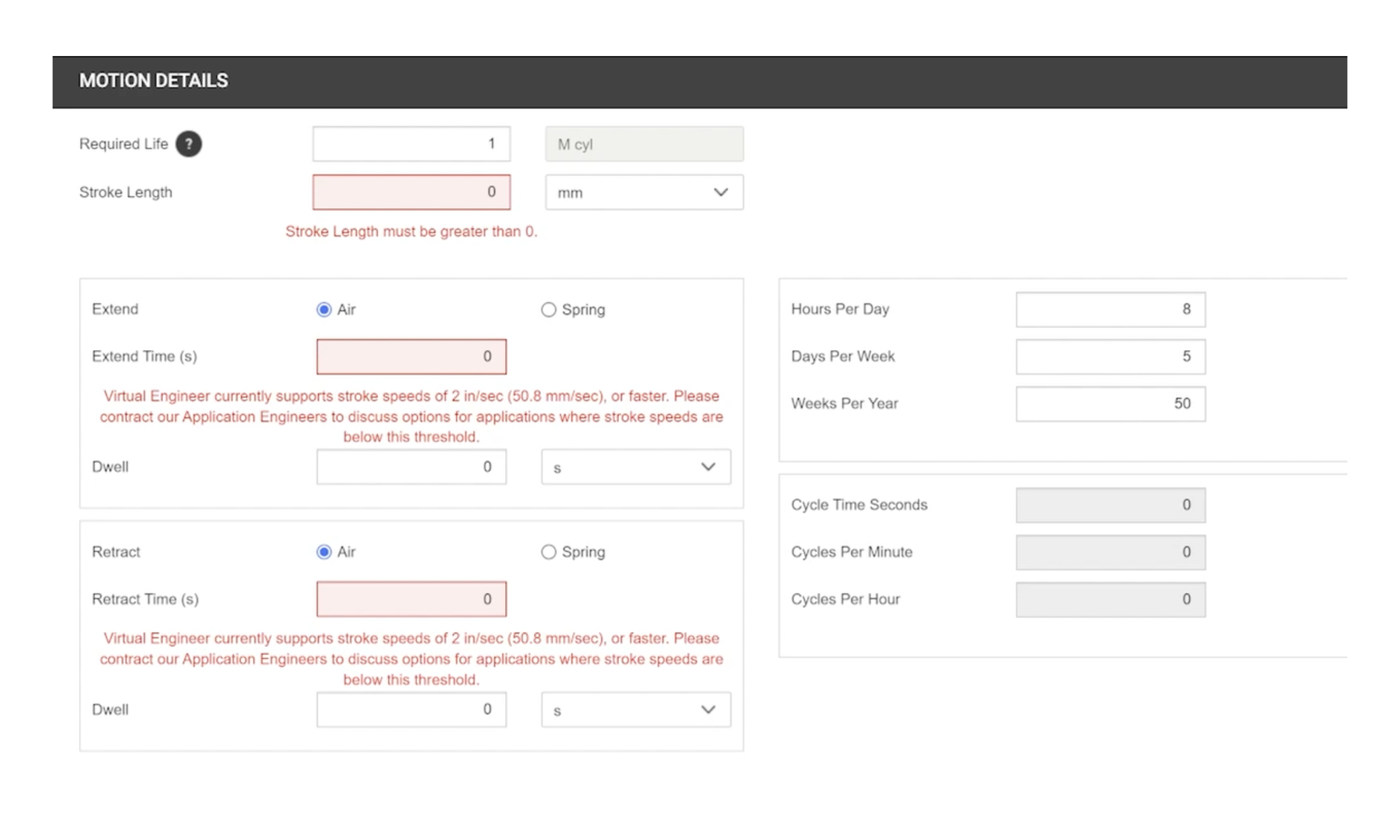
- Stroke Length and Timing: Enter the stroke length, extend time, and retract time as required.
- Define Pushed Mass: If applicable, enter the coefficient of friction for the pushed mass.
FINALIZE DETAILS & GENERATE RESULTS
- Complete Motion Detail Section: Enter values for the required fields in the Motion Detail section, including stroke length, required life, extend type, extend time, dwell time (if necessary), retract type, and retract time.
- Generate Results: Once all required data points have been entered, select "Generate Results." This process may take a moment as the tool evaluates the performance of various products.
COMPARING PRODUCTS
- Select Products: If desired, you can select specific products to narrow down the results, but it is recommended to select all products for a comprehensive overview.
- View Comparison Table: When the "Compare" button becomes active, click it to see a list of all products that meet your application needs.
- Review Product Information: The comparison table will display product details, including part number strings, series, bore, rod and bearing combinations, end-of-stroke options, and mounts.
- Evaluate Price vs. Performance: Use the comparison table to assess relative price versus cycle life, helping to determine if the added cost is justified for increased performance.
- Customize Comparison View: Click "Select Columns" to choose which information to include based on your project requirements.
- Generate Summary Report: Click the RPT button to obtain a summary report in PDF format that can be saved and shared.
FINALIZING YOUR SELECTION
- Configure Selected Product: Once you’ve decided on a product, click the "Configure" button to launch the Configurator.
- Pre-Populated Information: When you select a product, the Configurator will be launched with pre-populated information from the product you selected in the comparison table.
- Update CAD Model Preview: Click the update button to display and interact with your CAD model preview. It may take a few moments for the CAD file to load.
- Downloadable File Formats: Use the Formats tab to select from a list of downloadable file formats. Click the "Generate CAD" button to download your file.
- Save Your Project: Be sure to save your project by clicking the "Save and Proceed" button, which will take you to the My Projects section of the tool.
FORCES & MOMENTS
- Input Forces: Enter any component forces acting on the XY or Z axis, specifying start and stop positions.
- Visual Confirmation: As you enter data, representative arrows will appear in the preview below to confirm your inputs.
- Adjust Preview View: You can grab the actuator in the preview to change the view without affecting sizing.
- Add Additional Forces: Click the "+" to add more forces, each with its own start point, end point, and XYZ component forces.
- Input Moments: Enter moments similarly to forces. If a rotary assembly tool engages near the end of the stroke, define this as a roll moment.
- Toggle Between Forces and Moments: Switch the toggle above the image to view either forces or moments.
- Additional Forces: Add any additional forces such as spring, attached mass, or pushed mass as needed.

Need Assistance?
We're here to help.
For questions about Parker products or using Virtual Engineer, please contact technical support | pdn.technical@support@parker.com
To place an order or check the status of an order, please contact Customer Support | pdn.support@support.parker.com
For marketing-related queries, please contact the Parker Pneumatic Division Marketing Department | pdnmktg@parker.com
Visit Parker.com